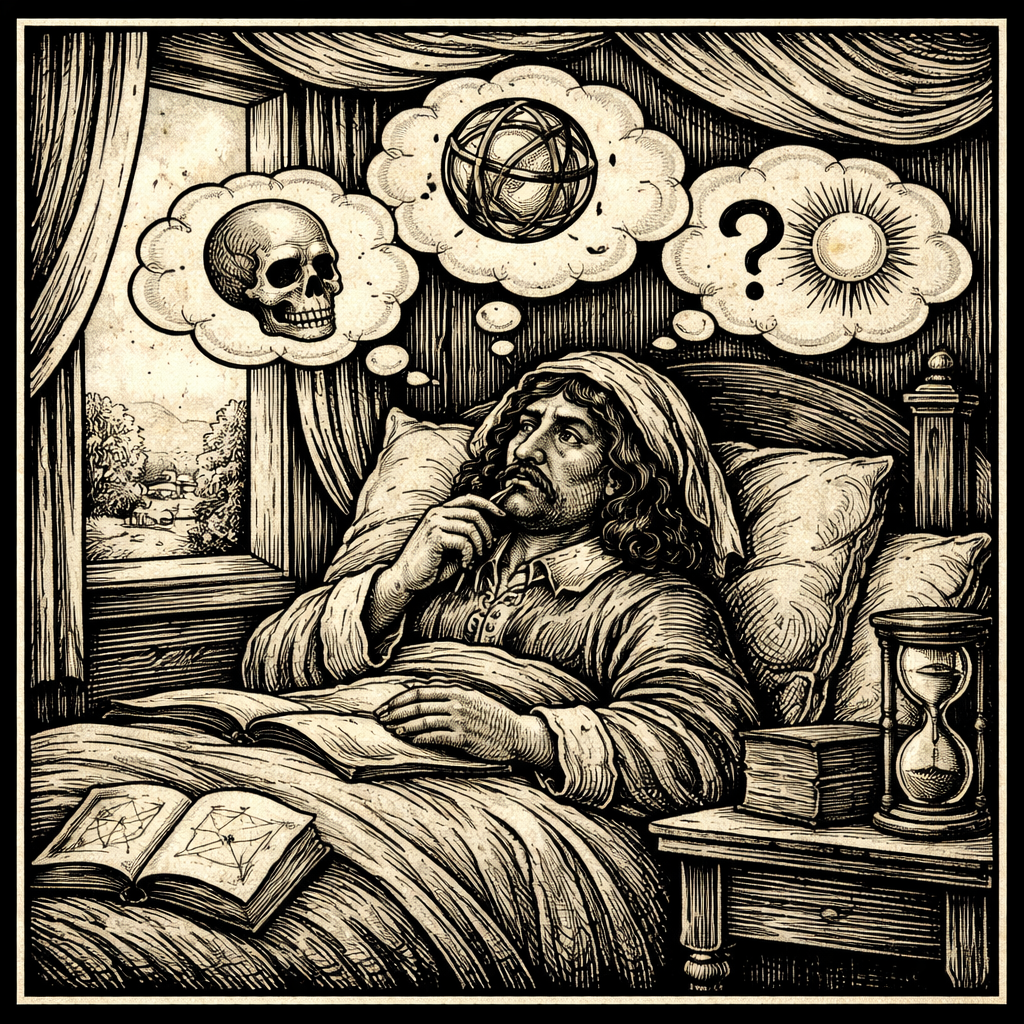
The Philosopher in Bed
March 31, 1596 - René Descartes was born on this day. He would help lay the foundation for modern philosophy, mathematics, and scientific thinking.
But here’s an interesting fact:
Descartes did some of his best thinking while lying in bed.
No, he wasn’t some lazy guy just slacking his life away — it was a strategy. He laid under the covers late into the morning, often in a warm, quiet room, letting his mind wander freely without distraction. In fact, one of his most important breakthroughs reportedly came while resting in a heated chamber during winter, where he began systematically doubting everything he thought he knew.
Out of that stillness came a simple but seismic idea:
What if the only thing I can be certain of… is that I am thinking at all?
From there: Cogito, ergo sum — I think, therefore I am.
Before Descartes, much of philosophy leaned heavily on tradition (especially Aristotle and the Church). He did something radical, he doubted everything. He asked, “What if my senses are wrong? What if reality itself is an illusion?” That became the foundation of modern philosophy—starting from the self, not authority.
Descartes believed that truth didn’t come from noise, crowds, or even books—but from clear, quiet reasoning, stripped down to its essentials. And for him, the ideal laboratory wasn’t a workshop or a university hall… It was a bed. Warm. Silent. Undisturbed.